
Showing posts with label video games. Show all posts
Showing posts with label video games. Show all posts
Wednesday, 18 April 2018
Final Game Sketch: Club Baths
Club Baths is a walking simulator set in a gay bathhouse. The title is a reference to one of the four gay bathhouses that were raided by the Toronto Metropolitan Police in 1981. When the game
starts, you find out that you’re a researcher who’s doing work in the office
and the owner calls you to propose that you take the night off and explore the
bathhouse instead. At this point, any choices you make will still result in the
owner directing you to where the keys to the door is located and it is up to
you whether to take up his offer. There are certain things in the office that
you can interact with, such as a Grecian statue, some documents lying on the
floor and on the shelves and some books. Once you are ready, you can find the
key and open the door to the bathhouse. As you walk through the hallways, you
find other statues and things you can interact with scattered throughout the
space. Most of the statues are snippets of poetry There isn’t a clear structure
or linear narrative and you are free to wander and discover all the pieces of
the puzzle on your own. Once you have interacted with most of the things in the
space, you will be able to solve the last puzzle, which is big piece of marble
that, once you’ve selected all the correct answers, opens up to a waterfall
which leads you to a black room, and the music changes once you enter the room.


Saturday, 31 March 2018
GDC 2018
This year I was
accepted by Different Games to attend Games Developers Conference in San
Francisco as one of their ambassadors. Different Games is a collective of
alternative and indie game designers, educators and other DIY voices in games
that hosts conferences, workshops and other events around the US and Canada. It
was an incredible experience to be able to attend such a big industry event as
a graduate student and my goals for the week was really just to try to learn
and do as much as I could without burning out.


Different Games
hosted a mini-conferences for all the ambassadors to introduce themselves and
their work/research on the day before GDC opened which served as a great way to
begin some conversations that would last the week as we bump into each other at
different north east south west halls of the Moscone Center half zombified. I
started off GDC by attending most of the level design workshops and the rest of
the week was filled with other level design related talks and a few narrative
and storytelling talks. I consciously chose to go with more workshops as oppose
to social and political talks. Not to diminish the importance of politics and
activism in games and games industry (it was a good year for that too
#unionization), and of course in my academic work I write extensively about the
political dimensions of video games and play as a necessarily counter to capitalism,
I just felt like since I have been to many academic conferences in my life and
I will be presenting at the Canadian Game Studies Association Conference in
Regina later in the year, I would do something different. Some highlights
include:
Wednesday, 7 February 2018
Game Story: NPC Dialogue Interaction with Yarn
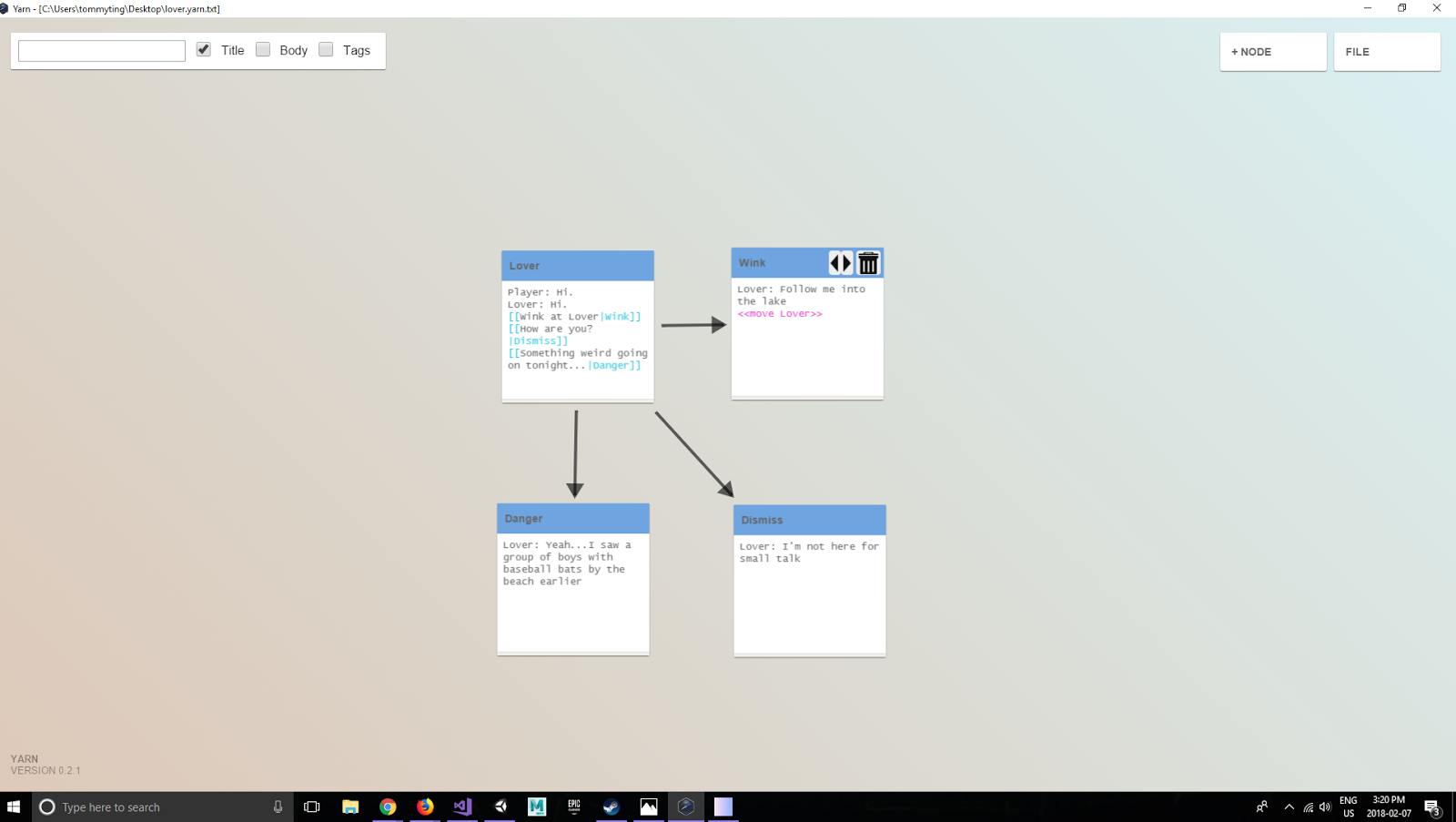
For my second game sketch assignment I chose to develop Game Story. I looked around typically used game narrative tools such as Twine and Fungus and came across a Twine-like Unity plug-in called Yarn (thanks Robert Yang!).
As mentioned in Robert's blog, it is a plug-in for Unity that helps you write stories and to create NPC dialogue interaction. It works really well as one massive monologue or multiple pieces of dialogue.The plug-in allows you to add as many text files as you need and integrates it all into the game for you. Robert has also created a tool for Yarn users called Yarn Weaver to test and debug their text without having to implement it into Unity right away.

As mentioned in Robert's blog, it is a plug-in for Unity that helps you write stories and to create NPC dialogue interaction. It works really well as one massive monologue or multiple pieces of dialogue.The plug-in allows you to add as many text files as you need and integrates it all into the game for you. Robert has also created a tool for Yarn users called Yarn Weaver to test and debug their text without having to implement it into Unity right away.
Thursday, 1 February 2018
Subversive Play: Gone Home
For my subversive play, I chose to play the game Gone Home by
Fullbright Studios. Gone Home is an adventure exploration game where the
player comes back to an empty house after backpacking in Europe. Inside
the house the player needs to find clues and piece together information
as to why her parents and her sister have left. The game is very much
driven by its narrative and has basic mechanics of picking up and moving
items around in order to unlock the mystery. Finding certain items,
usually letters unlocks the story in a linear manner.


I decided to subvert a game that I have already play once before because
I believe that it is easier to subvert a game that you already
understand. Though I would like to prove myself wrong by trying to play
subversively with a game I have never played before too! In the first
scene, I started picking random things from around the house and placing
it by the entrance lobby. I started going deeper into the house and
noticed that there were a big selection of “soft” objects such as
tissues and pillows. I immediately gravitated towards such objects and
started piling them on the staircase.
Game Sketch Iteration
For the game I am making for my Digital Games class, I am taking references from personal experiences and historical events and using queer theory and performance theory to think through my design challenges.

In 2001, a gang of men with baseball balls and a pool cue killed Aaron Webster in an area of Stanely Park in Vancouver frequented by gay men. Since then, numerous mysterious deaths and missing persons have occurred in Stanely Park. Most recently an international student went missing and was last seen around the Stanley Park's side of the Lion's Gate Bridge. I am not claiming that these are all people who went to Stanley Park for cruising, but I am interested in the park as a site because its beauty and popularity exists in parallel with its seedier underbelly.
Subscribe to:
Posts (Atom)
-
 Available for download here - http://github.com/sabresaurus/SabreCSG “SabreCSG is a set of level design tools for building complex leve...
 -
 In the last two weeks, our thesis class asked us to apply numerous design thinking and ideation methods in our prototyping process. Personal...
 -
Types of Testers Peers (Ramona, Kylie, Emilia, Jad) People who have not seen my progress (Kate) Ideal user-testers (Roxanne) Queer Fri...

Explorations in Level Design Part 4
Final Level Design Walkthrough In my final level design exploration, I designed a level that was inspired by the the Last of Us with so...
